Tuesday, December 6, 2016

In the News: CBS


Hundreds Gather At Vigils For Ghost Ship Fire Victims


SAN FRANCISCO (KPIX 5) — Across the Bay Area, friends and family gathered at candlelit vigils to mourn those who died in the Oakland warehouse fire.
Lights lifted to the sky Monday night around Oakland’s Lake Merritt as at least a thousand mourners gathered to pay tribute to those who died in the Ghost Ship fire.
For days, the local arts community in the East Bay has been in shock. Monday night, they were in mourning.

An artist who calls herself Mz. Butterfly told KPIX 5 the creative community in Oakland is close. She was grieving for sound engineer Barrett Clark, one of those still missing and unaccounted for in the wake of the fire.

“It’s affecting the community deeply,” said Mz. Butterfly. “Everyone in Oakland and beyond has been affected by this tragedy.”

She also knows Derrick Ion Almena, the controversial master tenant who has faced backlash for throwing the party in a warehouse that was not up to code.

Continuing Coverage: Deadly Oakland Warehouse Fire

“All I can tell you is that he’s a very horrible person and he has a long history of harming people,” she said.
Monday night, amid the anger there was also love. One man held a sign that read “HUGS HERE.” Oakland resident Chris Edwards, who said he lost friends in the fire, handed out free candy.
“Lost a lot of friends and my friends lost friends,” said Edwards. “I’ve just come out to show love for the people who were lost.”

He, like many others at the vigil, was still reeling.
“It’s been intense. The loss of life has been devastating,” said Edwards. “And beyond that I worry about the artist community and if it’s gonna be destroyed.”

Edwards said he has already heard tales of city officials knocking on the doors of other artist’s compounds in search of violations.

His fear: that the ripple effects of this tragedy have just begun.

As many as 50 people gathered in San Francisco’s Castro District Monday evening for a candlelight vigil in honor of Oakland fire victims.

The vigil at Harvey Milk Plaza, hosted by Rev. Megan Rohrer and other local transgender religious leaders, highlighted the fact that many of the victims of Friday’s three-alarm fire and others affected by it were transgender persons.

Rohrer, the first openly transgender pastor ordained in the Lutheran Church, said she had been called Friday to help minister to the families and friends of victims. Authorities have found 36 bodies so far in the wreckage of the Fruitvale warehouse art space known as the “Ghost Ship,” which caught fire Friday around 11:30 p.m. during a party and electronic music show.

“I heard of the great need for there to be a space for the transgendered individuals who are mourning their friends, who might not have a safe space to mourn in,” Rohrer said. “Who might, in addition to their love of music and art, be in a warehouse because it was one of the spaces that they felt safe in.”
Rohrer noted that one of those confirmed dead in the fire, Cash Askew, was a popular transgendered musician.

Askew performed with the group Them Are Us Too.

Rohrer noted that authorities were taking care, as they identified the dead, to confirm the preferred gender and names of transgender individuals.

In some cases, however, she said identification and notification of family had been slowed by difficulty in determining individual’s legal names.

TM and © Copyright 2016 CBS Radio Inc. and its relevant subsidiaries. CBS RADIO and EYE Logo TM and Copyright 2016 CBS Broadcasting Inc. Used under license. All Rights Reserved. This material may not be published, broadcast, rewritten, or redistributed. Bay City News Service contributed to this report.

Thursday, December 1, 2016

In the News: Bay Area Reporter


Trump election raises housing, homelessness concerns
Published 12/01/2016 

Federal funds for homelessness and housing programs could dry up under a Trump administration, leaving city officials scrambling to determine how the services can be maintained if President-elect Donald Trump follows through on promises he's made to deport undocumented immigrants and penalize sanctuary cities like San Francisco.

The city could lose as much as $1 billion per year in federal funding, leaving advocates concerned about where that shortfall would be made up and about how housing services would be provided to the homeless, seniors, immigrants, and others.

Mayor Ed Lee and the Board of Supervisors have reaffirmed San Francisco's sanctuary city status, and Lee said at a unity rally after the election that San Francisco would remain a welcoming place for all, including LGBT people, people of color, and all religious faiths.

Earlier this month, Brian Cheu, director of community development for the Mayor's Office of Housing and Community Development, held a forum to assess the housing needs of the homeless, senior, and LGBTQ communities. Also mentioned was how programs could continue being funded should the city lose its federal funding during a Trump administration.

"Currently our department was asked to provide a summary of our current federal dollars and what it supports so that the mayor could better understand how a cut to our federal funding would affect our department," Cheu said at the November 17 meeting. "The mayor will look at available funding sources to see how the general fund and other sources would be used to maximize the availability of existing services and avoid losing valuable community resources."

Cheu also said that it was too early in the budgeting process for the city to finalize strategies should certain significant funding streams be eliminated.

Around 100 people attended the forum at the Castro Senior Center inside Most Holy Redeemer Catholic Church at 110 Diamond Street. The meeting was divided into three groups. Elena Chavez Quezada, senior program officer for the Walter and Elise Hass Fund, led the homeless discussion. Clinton Loftman, who also works with the Mayor's Office of Housing and Community Development, facilitated the senior housing discussion. The HIV and housing discussion was led by Pastor Megan Rohrer of Grace Lutheran Church.

Andrea Aiello, executive director of the Castro/Upper Market Community Benefit District and Tommi Avicolli Mecca of the Housing Rights Committee both participated in the homeless discussion. Aiello addressed the Castro Cares programs, which puts community monitors out onto the streets of the neighborhood to help lead them to the services they need.

"Homeless outreach is about getting to know people," she said. "How can that happen when monitors are out there for two hours every six months? While we've touched a lot of people there's a gap. Something is missing. We're not quite providing what the people need."

Avicolli Mecca said people need to fight evictions and see that more housing is built.

"We need to decriminalize homelessness – we need to involve homeless folks in the discussion. Why is there no shelter in the Castro? Our community has a homelessness crisis," he said.

One homeless man who declined to give his name spoke up during the discussion. "We need to lean on the tech companies," he said. "Make them come through with funding. It's disgusting that we have so much wealth – there should be no one on the streets."

He also mentioned mental health concerns, noting that in his experience psychiatrists were shying away from homeless services because they could charge higher fees to tech workers.

At the HIV table, people were expressing concern about the possibility of funding cuts. Several people mentioned that the housing policies that have been developed in Salt Lake City were a good model for San Francisco to follow. Salt Lake City – and the state of Utah – has decreased homelessness by 91 percent by increasing the services it offers and by sending more outreach workers into homeless communities.

Rohrer spoke to the Bay Area Reporter after the meeting.

"Before the meeting, I thought the most emergent issue would be a response to the projected loss of $2 million dollars in HIV/AIDS housing funds due to federal recalculations," Rohrer said. "After listening to the needs of advocates, service providers, and legal advisers supporting individuals with HIV/AIDS in San Francisco, I now understand that the potential loss of federal funding is across a wide range of important intersectional issues affecting vulnerable San Franciscans."

Rohrer, who uses gender-neutral pronouns, said that they were pleased to learn about a new computer portal that will soon streamline the application process for low-income housing. The portal will also email individuals when housing that matches their criteria becomes available.

At all three discussions, the scarcity of available housing was an ongoing issue. Some noted that the cost of building affordable housing has limited the city's ability to match the needs of its low-income residents, while others argued that the city could build the housing regardless. A number of people expressed support for the city's new Department of Homelessness and Supportive Housing, which aims to streamline all services under one roof.

"While it's always good to have discussions on this topic, the simple fact is that the city has to provide housing to the homeless," Avicolli Mecca said. "Why is the city continuing to build luxury housing for the rich? We especially need housing for the homeless in the Castro. The LGBT community has high rates of homelessness and poverty – yet in the past six years no housing for the homeless has been built in the Castro area."

Aiello pointed out that a lot of the suggestions made at the meeting had been heard before.
"The city knows what needs to be done," she said. "It just needs the political will to do it. Optimism was expressed about the city's move to bring all services under the new Department of Homelessness and Supportive Housing. I share that optimism, but strong leadership and the political will will be needed."
Cheu said that he was pleased with the meeting. He called the evening "an honest, civic dialogue about important issues such as civic housing, housing for HIV-positive folks, and the homeless."

"As we were holding the meeting in the Castro, these three issues are of key importance both to the city at large and specifically to the Castro community," Cheu added. "There was a good mix of stakeholders represented, and that being said, there is always the need to have even more constituents present who are affected daily by these issues."

Tuesday, November 1, 2016

In the News: NationSwell


Rose Broome of HandUp

HandUp's innovative technology is revolutionizing how donors connect with those in need.

The seed for HandUp, a crowdfunding site that solicits donations to help the homeless, was planted in early 2012 when Rose Broome passed a shivering woman huddling in the doorway of a real estate office in San Francisco. “On a cold night, I was walking down the street and saw a woman sleeping on the sidewalk,” recalls Broome. “She didn’t have a jacket, she didn’t have a sweater — just a thin blanket protecting her from the cold ground.” That night, Broome says, “I made a commitment to myself to do one thing to make a difference, and that one thing turned into HandUp.”
The platform for HandUp allows those battling homelessness to appeal directly to donors to fund their particular needs. Since 2013, more than 2,000 people have raised nearly $1.6 million. By sharing their stories on the site, those in need are able to fundraise for housing assistance — security deposits, moving costs, help paying back rent, and so on — as well as for food, education, medical care and technological access. “Having a phone, the Internet, the ability to text is extremely important for everyone, especially for the most vulnerable people,” says Broome, who, besides cofounding HandUp, acts as its CEO.
The need for funding is enormous. Nationwide, 3.5 million people struggle with homelessness every year, and 50 million people live below the poverty line. But there’s a misconception about what being homeless looks like, says Broome, pointing out that the image of a person sleeping on the street, wrestling with mental health issues or drug addictions (or both), tends to capture the public’s imagination. In reality, however, 30 percent of those who are homeless are part of families. As Broome puts it, “You could walk right past 80 percent of people experiencing homelessness and not know any different.”
HandUp works by partnering with organizations that serve homeless populations. These organizations help their clients sign up and create profiles on the site (to date, they’ve launched more than 5,800 campaigns in 29 cities). When donors give, the money goes to the organization, which will pay for the items requested. Donors get an email update when their money has been put to use. HandUp also helps homeless people create donation request cards, which they can hand out to people they meet on the street, and donors in San Francisco can buy HandUp gift cards in $25 increments and distribute them when they meet someone in need (the cards can be used for groceries, clothes and other goods at HandUp’s nonprofit partners).

Join the cause! Help those experiencing poverty or homelessness. Read their stories, then post a message or make a donation here.

Broome and her cofounder, Sammie Rayner, are passionate about using technology to solve problems and create change. “It’s surprising, but right now, only 8 percent of charitable giving happens online,” Broome says. And unfortunately, the nonprofit sector tends to lag far behind the private sector in adopting new technologies. “So often, nonprofits are the last to get some of the best technology to do their work,” adds Rayner.
For the nonprofits that work with HandUp, the platform allows them to fund needs that wouldn’t otherwise be met, filling in the gaps left by restrictive government and foundation grant funding. SF Cares, a collaborative project of several Lutheran churches working to serve low-income and homeless individuals in San Francisco, has used HandUp to raise $18,000 for the needy they work with, plus another $20,000 toward their general operating costs. “They’re funds our organization never would have gotten before,” says the Rev. Dr. Megan Rohrer, the executive director of SF Cares and pastor at Grace Evangelical Lutheran Church. And the people doing the giving through HandUp are new donors that SF Cares might not have reached on its own, she adds.
Rohrer says she loves the way HandUp lets people combatting homelessness “speak in their own voice.” And she likes that the site lets people decide for themselves what they need to improve their lives. “Plus,” she says, “any time that I don’t have to spend fundraising means I get to eat with the homeless, and I get to sing songs with them too.”
Creating human connections is as much a part of HandUp’s purpose as developing innovative technological solutions. “On HandUp, you can read the stories of thousands of people who need help with very specific goals,” Rayner says. “As soon as people read the human story and have that connection through our platform, it’s harder to have the same stereotypes, and it’s harder to judge.” When donors give on HandUp, they can also post words of encouragement. The people who receive money through the site often say those kind words mean more than the donation, adds Broome. “A lot of people who are homeless feel invisible,” she says. HandUp helps them feel seen.

Monday, October 10, 2016

In the News: San Francisco Chronicle

Transgender pastor preaches to the choir with love

October 9, 2016 Updated: October 9, 2016 12:00pm

Rev. Megan Rohrer leads the Singers of the Street, a drop in homeless choir that meets every Monday.
Media: Erin Brethauer 
 
The voices intertwine like vines, three strands of harmony wrapping around words that make you cry if you think too hard about them and the people standing there singing them. But you don’t see tears on the Rev. Megan Rohrer’s face as she conducts this weekly session of Singers of the Street.

What you see is what you get pretty much most of the time the pastor talks: a smile so bright it seems to match the glow of the stained glass windows of the church she’s in.

Rohrer spends every Monday leading this little choir of mostly homeless people in song. And if there’s one thing that helps define Rohrer’s mission in life as one of the only transgender ministers in the nation, this may be it. In her — Rohrer, 36, prefers the pronoun “they,” but doesn’t quibble with occasional desires for conventional reference — role as pastor of the Grace Lutheran Church in the outer Sunset District of San Francisco, Rohrer is all about social justice and celebrating differences. About nurturing the goodness at the core of everyone’s soul. Corny stuff. But real.

“I’m going home, quiet-like, some still day, I’m going home,” Rohrer sings with the choir, left hand arcing up and down to conduct the musical flow. “It’s not far, just close by, through an open door...”
Most of the nine people in front of her don’t have the home they’re singing about. But for those moments they get to have with Rohrer every Monday, they’ll tell you they feel like they have something close to one — and it’s because of the radiant minister standing in front of them in a worn T-shirt and blue jeans.

“We love Megan,” says Kent Hollek, 62, who’d slept the night before on Van Ness Boulevard and carefully stashed his suitcase in a corner of the choir practice room. “She steers us. She guides us. I can’t think of anyone else like her.”
The choir gig actually comes with one of Rohrer’s other jobs in addition to her role at Grace Lutheran. She is executive director of the Welcome ministry, which works with the impoverished all over San Francisco and holds the Singers of the Street practices at First Congregational Church on Polk Street. Having other gigs is nothing new for Rohrer, who seems to be in perpetual motion writing children’s books, helping the homeless with everything from eyeglasses to music, leading garden projects for the community.

And this is all in addition to being a pastor who was born a girl in South Dakota, figured out early she was gender-neutral, and took charge of Grace Lutheran in 2014. That same year, she was honored by the Dalai Lama for her compassionate works.

“My motto is try everything,” Rohrer says. “If it doesn’t work, don’t mention you did that. If it does work, do it some more.” She says this with one of her trademark laughs. And she means it. In the most sincere way possible.


See a short film with Pastor Megan Rohrer and the homeless choir at www.sfchronicle.com/theregulars. The Regulars is a weekly photo and video column by Erin Brethauer that offers a glimpse into the lives of ordinary people in the Bay Area, caught in routine activities of modern urban life. If you know a regular, email regulars@sfchronicle.com.

Tuesday, September 6, 2016

In the News: Beyond Chron

Celebrating Compton’s 50th: Vanguard Revisited, W/ Rev. Megan Rohrer

by on September 6, 2016

Reverend Megan Rohrer
If you missed the prior events celebrating the 50th anniversary of the August 1966 Compton’s Cafeteria riots in San Francisco’s Tenderloin, don’t despair. On Thursday, September 8, the Tenderloin Museum hosts Reverend Megan Rohrer, who will honor the historic legacy of Vanguard, San Francisco’s first gay liberation group.

In 2011, Rohrer and historian Joey Plaster created a remarkable work of public history: Vanguard Revisited, which introduced the history of the 1960s radical queer-youth organization Vanguard to contemporary queer homeless youth, who created their own art and poetry zine in conversation with essays and themes from the original Vanguard newsletter. The new zine also featured archival materials, a historical narrative and writings from urban ministers and youth organizers.

The storytelling project Temporal Cities will attend the event to share and record LGBTQ stories. Listen to a piece of oral history in their rotary phone, or type your own memories on a real typewriter.
Temporal Cities is a public art project that examines the experience of living in the Tenderloin through the stories of its residents. For more information about the project, visit TemporalCities.org.

For the 50th Anniversary Compton’s Commemoration, a second issue of the Vanguard Revisited zine will be released with new materials by the original authors and editors. For the Tenderloin Museum program, Rohrer will describe the initial process leading up to Vanguard Revisited and will discuss its legacy. Rohrer is the pastor of Grace Evangelical Lutheran Church in San Francisco and is a nationally recognized leader on issues of homelessness, gender, sexuality and faith.

The Compton’s riot is only a part of the Tenderloin’s GLBT legacy. The Tenderloin was the geographic center of the city’s emerging GLBT movement from the 1940’s through the 1960’s, a story on display at the Tenderloin Museum.

ABOUT TEMPORAL CITIES
Temporal Cities will be stationed inside the Museum during the event, collecting stories related to the LGBTQ experience in the Tenderloin. Temporal Cities is a public art project that examines the experience of living in San Francisco’s Tenderloin neighborhood, through the stories of its residents. The piece combines analog slide projection and interactive storytelling; a projected image mounted on the street attracts passersby to the installation, where they are encouraged to share a personal story that took place nearby. In collecting and archiving these stories, artists Lizzy Brooks and Radka Pulliam are building a nuanced map that explores the changing nature of the city and our collective ideas of permanence.
Here is the ticket information.
Randy Shaw details the Tenderloin’s GBLT history in The Tenderloin: Sex, Crime and Resistance in the Heart of San Francisco

Monday, July 25, 2016

In the News: Hoodline

Tenderloin, GLBT Museums Host Events For 50th Anniversary Of Compton's Cafeteria Riot

One evening in August 1966, the Tenderloin's transgender community had had enough. After years of being marginalized by society and harassed by the police, a riot ensued at Gene Compton's Cafeteria, a favorite late-night hangout spot at 101 Taylor St.

The exact date of the Compton's Cafeteria Riot has been lost to time, and it saw much less publicity than New York's Stonewall riots, three years later. But San Francisco's queer and transgender community has not forgotten, and the Tenderloin Museum and the GLBT Historical Society will be honoring the riot's 50th anniversary with a series of special events running now through mid-September.
One of many Gene Compton's Cafeterias locations in the Bay Area.
Photo: Source unknown
The two organizations have teamed with veterans of the riot, as well as performers, historians, filmmakers and artists. Their events will honor not just the riot itself, but how life has changed over the past few decades for queer and transgender people.
To kick off the series, the Tenderloin Museum is hosting a queer history walking tour and reception at their Eddy Street location this Thursday, from 6-8:30pm. The $5 tour, led by drag performer and Castro District tour guide Cruzin d'Loo, will focus on both the riot and overall LGBTQ history in the Tenderloin. The tour will end at 7pm, just in time to join a free public reception at the Tenderloin Museum.
Other events in the series include a discussion with Felicia Elizondo, who participated in the riot and was the Lifetime Achievement Grand Marshal of the 2015 San Francisco Pride Parade, and a screening at the Roxie Theater of Screaming Queens, an Emmy Award-winning documentary that helped elevate the forgotten riot into public consciousness.

July

Tenderloin Queer History Walking Tour & Kickoff ReceptionDate: 6-8:30pm Thursday, July 28thLocation: Tenderloin Museum, 398 Eddy St.Tour: $5Reception: Free and open to the public
Starting at the Tenderloin Museum at 6pm, Cruzin d'Loo (the drag alter-ego of performer Kevin Wisney) will give an hour long walking tour of the LGBTQ history of the Tenderloin, centering on the Compton's Cafeteria Riot that took place at the now-famous intersection of Turk and Taylor Streets. The tour will return to the museum at 7:00pm. for a kickoff reception. Trans historian and award-winning documentary filmmaker Susan Stryker and original "screaming queen" Felicia Elizondo will speak briefly to mark the occasion.

August

Cruising the Tenderloin in the 1960s: A Talk by Felicia ElizondoDate: 7-9pm Thursday, August 4thLocation: GLBT Historical Society Museum, 4127 18th St.Admission: $5; free for members
Felicia Elizondo, a self-described "Mexican spitfire, screaming queen, pioneer, legend, icon, diva, 29-year survivor of AIDS and Vietnam veteran" was one of the transgender participants in the 1966 Compton's Cafeteria Riot. In 2015, she was named Lifetime Achievement Grand Marshal of the San Francisco Pride Parade. In this special multimedia presentation, she explores San Francisco's Tenderloin District in the 1960s to explain how the Compton's Cafeteria Riot was a defining moment in the struggle by a diverse gay and trans community to claim public lives and become who they were meant to be, paving the way for future generations.

Compton's 50th Anniversary Art Launch & Artist TalkDate: 7-9pm Tuesday, August 16thAddress: GLBT Historical Society Museum, 4127 18th St.
Admission: $5; free for members
Launch party and artist conversation for Compton's 50th anniversary works by ceramic artist Nicki Green and interdisciplinary artist Chris Vargas, commissioned by the GLBT Historical Society. Green is producing a limited-edition signature coffee mug referencing both Compton's Cafeteria and the riot itself, while Vargas is hand-screening a numbered set of commemorative T-shirts from his own design. In conversation, the artists will discuss their creative processes and the relationship between trans history and art. Both works will be available for a limited time exclusively at the GLBT History Museum and the Tenderloin Museum.
Green is a trans-disciplinary artist whose work focuses on craft processes that document history and create legacy for marginalized communities. She has exhibited her work nationally, notably at the Leslie-Lohman Museum in New York City and the Yerba Buena Center for the Arts in San Francisco. Vargas is an artist whose work deploys humor and performance in conjunction with mainstream idioms to explore the complex ways that queer and trans people negotiate spaces for themselves within historical and institutional memory and popular culture. Vargas also serves as executive director of MOTHA: The Museum of Transgender Hirstory and Art.

Screaming Queens: The Riot at Compton's CafeteriaDate: 7-9pm Thursday, August 18thAddress: Roxie Theater, 3117 16th St.Tickets: $12
Cosponsored by the Tenderloin Museum and the GLBT History Museum, a special 10th anniversary showing of the Emmy Award-winning 2006 documentary Screaming Queens: The Riot at Compton's Cafeteria, followed by a Q&A with directors Susan Stryker and Victor Silverman. The film uncovered and popularized the then-forgotten 1966 riot at Compton's.

Susan Stryker is associate professor of gender and women's studies and former director of the Institute for LGBT Studies at the University of Arizona. A leader in the field of transgender studies, she is the author of many articles and several books on transgender and queer topics, most recently Transgender History (Seal Press 2008). She won a Lambda Literary Award for the anthology The Transgender Studies Reader (Routledge 2006).

Victor Silverman is an award-winning filmmaker, historian and author. His current film, Getting High, is a provocative, feature-length documentary about his family's collision with drugs and alcohol set against a backdrop of American society's bitter conflicts around the "war on drugs." Silverman's latest book, coauthored with poet Laurie Glover, is California: On the Road Histories (Interlink, 2012).

September

Sex Work in the Tenderloin: Then and NowDate: 7-9pm Thursday, September 1stLocation: GLBT Historical Society Museum, 4127 18th St.
Admission: $5; free for members

A panel discussion exploring how trans lives and sex work have changed in the last half-century in one of San Francisco's most dynamic neighborhoods. Speakers include Tamara Ching, a Compton's veteran and longtime advocate for trans and sex worker rights, and several advocates with St. James Infirmary, which since 1999 has provided free, confidential, nonjudgmental medical and social services for current and former sex workers of all genders.

Vanguard Revisited With Rev. Megan RohrerDate: 6-8:30pm Thursday, September 8th
Location: Tenderloin Museum, 
398 Eddy St.
Admission: Free and open to the public
In 2011, Megan Rohrer and historian Joey Plaster created a remarkable work of public history: Vanguard Revisited, which introduced the history of the 1960s radical queer-youth organization Vanguard to contemporary queer homeless youth, who created their own art and poetry zine in conversation with essays and themes from the original Vanguard newsletter. The new zine also featured archival materials, a historical narrative and writings from urban ministers and youth organizers.
For the 50th anniversary of the Compton's riots, a second issue of the Vanguard Revisited zine will be released, with new materials by the original authors and editors. For the Tenderloin Museum program, Rohrer will describe the initial process leading up to Vanguard Revisited and will discuss its legacy. Rohrer is the pastor of Grace Evangelical Lutheran Church in San Francisco and is a nationally recognized leader on issues of homelessness, gender, sexuality and faith.

Saturday, July 9, 2016

In the News: San Francisco Bay Times

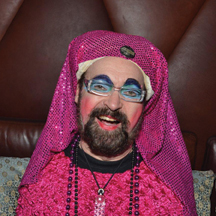
Sister Dana sez, “Now that Pride is over, are we supposed to feel shame? Just kidding! Pride is every day!”

Sister-Dana2Sister Dana sez, “Now that Pride is over, are we supposed to feel shame? Just kidding! Pride is every day!”

Sister Dana thoroughly enjoyed being the rainbow nun in the San Francisco Bay Times contingent #099 of the Parade. Our contingent included board members and volunteers of the RAINBOW HONOR WALK organization, highlighting legendary LGBT community leaders represented in the sidewalk plaques installed in the Castro neighborhood, where Rainbow Honor Walk founder David Perry rode as well. I was on the top of the double-decker bus with the OAKLAND INTERFAITH GOSPEL CHOIR. Joining our team were city officials, such as Oakland City Councilmember at-Large and San Francisco Bay Times columnist Rebecca Kaplan and her wife, Pamela Rosin. Sister Dana loved blowing kisses to the crowd and flashing peace & love signs—and receiving the same back from those loving people! I even got four seconds of fame on the KOFY-TV broadcast!

Just before the City came to dismantle the Orlando victims’ memorial in the Castro, several of us SISTERS OF PERPETUAL INDULGENCE held a CLOSING RITUAL AT THE ORLANDO MEMORIAL on the corner of 18th and Castro—known back in the day as Hibernia Beach. “I hate to see it go, as we are still raw from this act of violence, but the recent accidental fire has made it necessary for it to be dismantled,” said Castro Business District executive director Andrea Aiello. The memorial went up immediately after the shooting two weeks prior, which claimed the lives of 49 people at a gay nightclub in Orlando, Florida.

Sister Merry Peter acted as host for the ceremony, which drew close to a hundred people. Cleansing sage and smudge were distributed by Sisters, ministers, and leaders. As the majority of the Orlando people murdered were Latinx, it was appropriate that Ruben Martinez of  INSTITUTO DE LA RAZA open the circle in Spanish, with translation following in English. Rev. Megan Rohrer from Grace Lutheran (wearing a rainbow t-shirt with the punny phrase: “This is the gay that the Lord has made” proudly emblazoned) invited the community to share from their hearts (words, song, movement). Politicians, community leaders, and ministers were all invited to join in.
The next day, several of us Sisters and our friends assembled in Pink Triangle Park in the Castro to be led by Sister Kitty Catalyst in a First Friday Darshan Parade down Market Street—offering ritual blessing, love, and peace in the gayborhood....