
JUNE 17, 2020
A year after his 'Queer Eye' makeover, Philly’s Pastor Noah remains a changed man
At Atonement Church, everyone is welcome. But, as a gay member of the clergy, its leader was going through an identity crisis — until The Fab Five arrived.

 RYAN COLLERD/NETFLIX
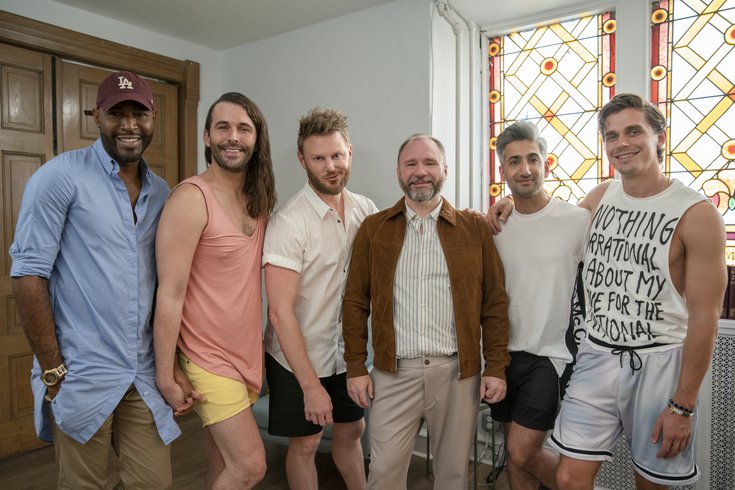
Pastor Noah Hepler and The Fab Five. (L-R: Karamo Brown, Jonathan Van Ness, Bobby Berk, Pastor Noah, Tan France, Antoni Porowski)
From the outside, it looks just like any other church. But inside the doors of Evangelical Lutheran Church of the Atonement in Fishtown lies a sanctuary, both figuratively and literally, for people from all walks of life, many of whom have been ostracized by religion at large due to their sexual orientation, race or gender.
With rainbow accent lights and a purple backdrop, however, it doesn't take long to realize you're in a different kind of church.
And the driving force behind Atonement becoming "the quirkiest church in FIshtown" is Pastor Noah Hepler, a man who has struggled with his own identity as a gay man while trying to navigate his way through a belief system and community that wasn't afraid to tell him in very plain terms that people who acted on those feelings would be sent to hell without a second chance.
For Pastor Noah, that struggle continued even after he came out to his then-wife over a decade ago. And it may have continued to this very day if not for the help of five very special people who he says changed his life in a profound way.
- MORE ON QUEER EYE
- 'Queer Eye' star Bobby Berk on filming in Philly, how the show has changed and keeping it real
- Queer Eye's Karamo Brown tells Jimmy Fallon that Philadelphians are 'tough nuts to crack'
- Philadelphia LGBTQ artist VINCINT is behind the new 'Queer Eye' song
- Queer Eye's Antoni says he ate way too much food at Zahav while filming in Philly
Last year, Hepler received a boost in the form of a visit from The Fab Five, the quintet who make up the new cast of Queer Eye on Netflix. And earlier this month, the fifth season of the hit show, which was filmed entirely in the Philly area, dropped on the streaming platform. Hepler and Atonement, which is located just off Frankford Ave., starred in the premiere, the first of a series-long 10-episode season.
If you're unfamiliar with Queer Eye, that's fine, but it's most definitely a series you should give a chance before dismissing entirely, especially those of you turned off by the name, because you're probably among those who could most benefit from its lessons.
"Honestly, I think it's more important [for straight people to watch]," Queer Eye design expert Bobby Berk told PhillyVoice. "The only way to change anyone's mind about negative feelings they might have about a group of people they know nothing about is by visibility. And that's not just for the LGBT community, that's for any human being."
A typical episode of Queer Eye is about an hour in length and follows the transformation of that episode's hero at the hands of The Fab Five, each of whom specialize in a different area. There's fashion aficionado (and French tuck enthusiast) Tan France; grooming master (and eternal optimist) Jonathan Van Ness; culture guru (and unlicensed therapist) Karamo Brown; food expert (and avocado advocate) Antoni Porowski, and Berk, who basically renovates your entire home, community center, or in this case, church (no big deal).
And after spending a week with them, you're guaranteed to be a different person — in the best way possible.
That was precisely the experience for Pastor Noah Hepler, who not only needed a new look, but the confidence to go along with it. And that was only scratching the surface.
For Hepler, a lifetime of feeling as though he didn't belong, as if he was an imposter within in his own life, had led him to a stagnant place, one that found him timidly leading a small congregation and living in a building that had mold from a leaky roof. He didn't much worry about his appearance, and although he knew something needed to be done, he lacked the motivation to make the change himself, largely because he failed to see that he was a worthwhile cause.
As a pastor, he had no problem helping others, but when it came to his own life, he was lost.
"I think the biggest thing for me personally was helping me identify what was wrong," said Hepler, sitting in the still-brand-new looking break room at Atonement. "I mean, is it possible I could've done it on my own? Probably, but it would've taken me a lot longer and therefore drug the congregation through a lot more of me trying to figure out what I was doing. So they at least accelerated it, but I think being able to identify problems — again, every one of the [The Fab Five] touching on one aspect or another of how I was hiding myself from myself — I think they really identified that for me and I think that was one of my biggest issues."
***
For Hepler, his issues stemmed from the fact that he grew up as a closeted gay man in a very religious household, one that taught him that all gay people are destined for hell and worse. In denial of his sexual orientation, Hepler married and became a pastor of the Lutheran faith, despite the fact that at the time the church had still not changed its views on homosexual clergy (although that has since changed), and lived what he called "a lie that I had been told that I had begun to believe."
Eventually, Hepler knew he couldn't continue like this, and he came out to his wife.
"That was really tough, and it was really the center for a lot of the guilt that I felt," Hepler said. "Not just her, but her family and everyone else that I kind of drug into what I now describe as a lie that I had been told that I had begun to believe. And now, I felt guilty about pulling other people into that, so we actually spent a year trying to process through what this would mean. And it just seemed as time progressed that divorce became more inevitable. There was just no way out of it.
"We kind of joked and they would say, 'There's nothing you can do about it now; we've already submitted it.' And I laughed and said, 'That's fine, because nothing that interesting ever happens in my life.'"
"And [pause] so it was tough because I care for her deeply, and yet I was also realizing that I was going to have to radically change our relationship because it was on the way — the trajectory it was on was going to end in a very bad situation for both of us. So I felt like after we had had some difficulty and it was dawning on me that I think I know what's causing this, I needed to admit it. So that's what started that.
"It still bothers me. I wish I could go back in time and do it differently. Hindsight is always 2020, but I think we'd still end up in the same place. It's just there's things that I know now that would have made it a lot easier back then for both of us."
Hepler says the two no longer communicate, and although at times he wishes they still did, he believes it's for the best.
Following his divorce, Hepler was looking for a new start at a new congregation, but because the recession had hit his home state of North Carolina earlier than others, there were a limited number of openings, so he decided to return to school to finish the doctorate he had previously started. That led him to the Philadelphia area, where he earned his degree and eventually landed at Atonement, where he's been for the last six years.
Atonement itself is also partly responsible for Hepler's appearance on the latest season of Queer Eye, as a parishioner and member of the church council found the flyer and nominated him.
"So, it was a parishioner who found a flyer, who also happened to be a member of [church] council at that time," Hepler explained. "And, I think, they just found it lying around somewhere, that's the one detail of it I don't really remember. So they did the questionnaire — and obviously did a good job — and submitted it, and then they texted me and said, 'Hey, I just nominated you for Queer Eye.'
"So I knew I had been nominated, but we kind of joked and they would say, 'There's nothing you can do about it now; we've already submitted it.' And I laughed and said, 'That's fine, because nothing that interesting ever happens in my life.' And so, I think it was within a couple of days, a week tops, the person who nominated me contacted me and said there's a casting director that would like to talk to you tomorrow. And it just went from there."
***
 RYAN COLLERD/NETFLIX
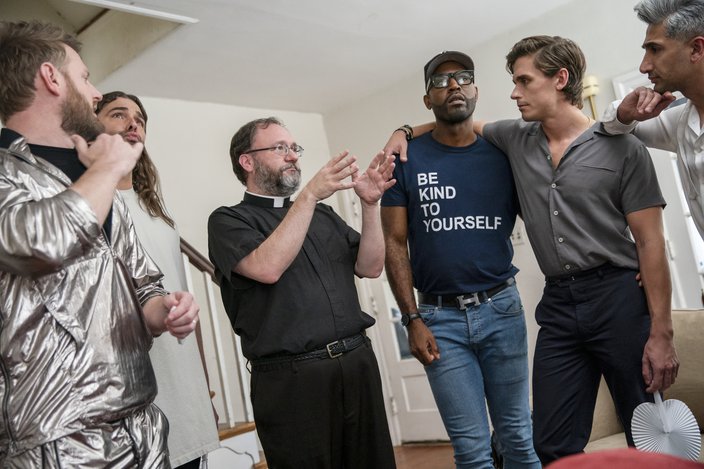
A pre-makeover Pastor Noah, center, meets with The Fab Five for the first time.
The next thing Hepler knew, Netflix gave the green light and he was destined for a week with The Fab Five. What he didn't know, however, was when they would arrive and what exactly that experience would be like.
"I knew that I was going to be on [the show] but I had no idea what it was going to be like," Hepler said. "You hear a lot of stories about reality TV actually be an over-produced, sort of scripted thing. That was not my experience with the Queer Eye team. In fact, there was one part that's some of the B-roll footage where the producer said this would be some of the most produced part, and after that it's going to be the camera, the Fab Five and you, and we're just going to fade into the background. And that was my experience.
"At that point, it just becomes a conversation like the one we're having, except there's a camera there that you know eventually is going to produce [a show]. And I've got to say, now that I've seen the episode, it's an accurate representation of my experience with them. So are the surprises in the show — the show's just very genuine."
And that includes the surprise appearance by The Fab Five at the beginning of every episode, which was hard to believe was authentic given there's always a camera in the room before they arrive. But Hepler says he was never told they would be arriving that day, only that a film crew from Netflix would be there for some background footage. In fact, The Fab Five didn't even realize this until Season 3 or 4, according to Berk.
"We never really understood. We're like, 'God, why do they always act so surprised? Obviously they know we're here,'" Berk explained. "And it wasn't until — I don't even know what episode it was — our executive producer was like, 'Wait, you guys think they know you're here?' And we're like, Well, don't they?' And they were like, 'No. We always just tell them that we're filming their backstory... and you're coming another day.' And we went, 'Ohhhhh, we get it now!' [laughs]."
But that day that began as any other quickly morphed into the beginning of the transformation of a lifetime for Hepler.
"They're real people, who are absolutely wonderful, who are helping other people, and by extension everyone else who sees the show," Hepler said of The Fab Five. "They're just helping people see how beautiful they are, and by extension, I was already feeling like maybe I need to start looking at myself differently. And then to have them here and walk through that, that's exactly what they're doing."
Berk also said the authentic nature of the show is just that: authentic. It's actually something they actively work on throughout filming, trying to make the hero forget they're on a television show. If something great is said off camera or the audio wasn't turned on, too bad.
"It's when we get them to forget there are cameras there and get them to forget that they are on a show is when we get an authentic experience, not only for the viewers but for our hero," Berk added. "We're always so, so aware — like when the cameras aren't rolling, we go out of our way to separate ourselves from the hero because we always want to make sure that the conversations that we're having on camera are real organic conversations. We don't want to accidentally talk to them about something off-camera and then we're like, 'Oh, God, this totally needs to be something that's on camera.' And then be like, 'Remember what we were talking about before? Talk about that again.' Because then it becomes unauthentic."
"One of the things he said, 'When someone is suffocating you...it's not your fault for trying to breathe.' And to me, that re-cast the decisions that I had made as not my fault, but a systemic problem that the church has..."
Before meeting Jonathan, Bobby, Antoni, Karamo and Tan, Hepler wasn't feeling all that beautiful, both inside and out. And with each member of The Fab Five, there was a different part of Pastor Noah that needed work.
With Antoni, Hepler got out of his comfort zone as he was surrounded by "a gaggle of gays" in the kitchen. Jonathan showed him the transformative beauty of a haircut and a shave. And Tan helped him realize that there's life beyond cargo shorts and t-shirts, which was the area Hepler identified as the biggest basic change he needed to make heading into the makeover.
"It's definitely a net effect," Hepler said of his experience on Queer Eye. "All five of them, they work as a team even though they're doing their own thing and you're meeting with them separately. I don't think it's planned, although maybe they do, but it just seems like a very natural thing from their own cohesion together as a group."
MORE: Queer Eye's Bobby Berk talks filming in Philly, how the show has changed and more
Each episode also allows for a different member of The Fab Five to shine, and in Hepler's case, it was Karamo and Bobby who helped facilitate two of the most moving and impactful moments of the episode, the kind the hero never sees coming but often leads to the most meaningful change possible.
With Karamo, it was a meeting he facilitated with two other LGBTQ figures in the Lutheran faith, Bishop Guy Erwin, the first openly gay bishop in the church, and Pastor Megan Rohrer, the church's first trans pastor, that opened Hepler's eyes to the fact that he was not to blame for his negative experience with the church and the way its affected his life.
"I went in wondering what my time with Karamo was going to be like," Hepler said. "Culture? Is he going to take me to a rock-climbing gym or something like that and help me with my imposter syndrome, that negative script? Which, he did [not the rock-climbing part of it]. I don't know how he picked up on it, I guess he's good at his job — but he got to a really big roadblock for me that I wasn't — I mean, I knew it was there, but I didn't know how much it was just sitting in my life. The guilt that I felt about what had happened with people.
"One of the things he said, 'When someone is suffocating you' — and in this case that someone was what I believe are unfair misapplications of what scripture is saying and how it's been applied to me — 'it's not your fault for trying to breathe.' And to me, that re-cast the decisions that I had made as not my fault, but a systemic problem that the church has that I was trying to figure out how to navigate and be a good faithful Christian. And then there's a domino effect when someone helps you out like that. What I remember thinking is that I wanted to defend the church; I was like, no, because the church has been nice to me now. But then it was that realization that in those experiences of vulnerability for me about my own story, I was experiencing a peculiar kind of strength."
***
The time with Bobby was something else entirely. Like Hepler, he was raised in a strict Christian household and a church that vilified homosexuality. And for someone who knew at very young age that he was gay — and prayed that God would make him straight — that was a life-altering experience that he still struggles with to this day.
In a previous season, Bobby had already reckoned with his issues with the church — although he still refused to enter the church itself — and went into greater detail about how those struggles shaped his life, something he was unwilling to do originally, but was forced into when a last minute schedule changed landed the The Fab Five at Mama Tammye's church in Gay, Georgia.
"You know, I think I've just had more time to process it," Berk said of the differences between the two church visits. "The Mama Tammye episode, I almost refused to do — actually in the beginning I did refuse to do it. That was shown as the first episode of Season 2, but it was actually the very last episode that we shot. And it was an episode that was sprung on us about 48 hours before we shot it. The original hero that had been cast for that episode fell very ill and production had to re-cast that episode very quickly. ... After the medical issue happened, not only was she the best option but in the end, I mean, I'm so glad we did it. But she was one that was queued up, and was ready to go. So I didn't have a lot of time to process it.
"I also hadn't seen Queer Eye yet. None of our episodes had come out. We were still filming Seasons 1 and 2 together. I was having a lot of emotions doing that whole season, because none of us had to expose ourselves emotionally like we had been doing for the last three or four months, and I was kind of just emotionally drained. And I didn't have the strength. But at the end of the day, I'm very glad we had the chance to share what we and Miss Tammye showed each other, because I think that her show had a huge impact on the world. And she has had a huge impact on the world, and continues to have a huge impact on the world. And she's allowed for a lot of healing for millions of people, so I couldn't be happier that we did it."
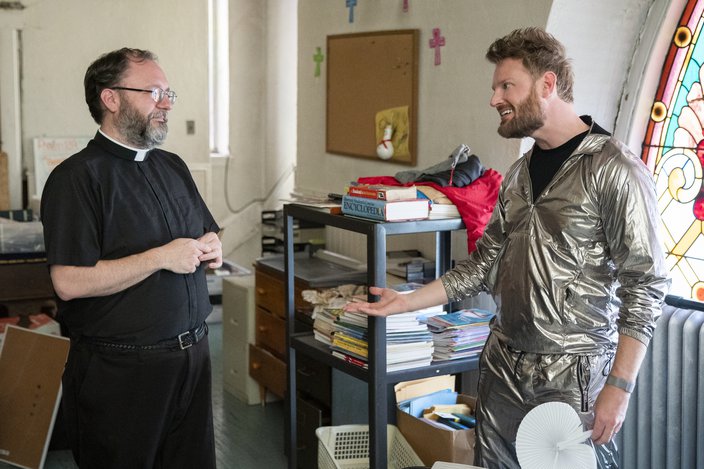
Unlike Hepler, Bobby has never returned to the church after coming out. And although he managed to cross the threshold at Atonement, he still wore a "fire-proof suit" into the church for the surprise at the beginning of the episode.
 RYAN COLLERD/NETFLIX
Pastor Noah Hepler and Bobby Berk, rocking his “fire-proof suit.”
"My feelings have definitely changed, because I've had time to process it," Berk added. "I've had time to put the emotions where they need to be and learn how to protect myself from those emotions, where back then, I didn't. [The Mama Tammye episode] was sprung on me so quickly, I was like, 'Nope. I didn't even want to do this episode, I am not walking in this church.'
"Atonement, though, is a very different kind of church. And so I definitely felt more comfortable walking into that church knowing that it was a church that accepts the LGBTQIA+ community and that the pastor was gay. So have my views on religion changed? No. But some of the pain that it's caused me has healed."
Despite that both these men were greatly harmed by their church's views on their sexuality, they both wound up on very different paths. And by the end, after spending some time with Hepler and seeing this different type of church, it was clear the impact the pastor had on The Fab Five's design guru. Following a conversation in the car in which he explains to Bobby one example of how positive views of homosexuality have been more or less written out of the scripture — not to mention his own revelation during his time with Karamo — Hepler does something unexpected.
He apologized to Bobby on behalf of the church.
"I just felt like anybody who's experienced what I have needs to hear an apology, even if it's from somebody who just represents the institution but hasn't actively participated, because, in fact, I heard the same thing from Bishop Guy, who is an openly gay bishop, the day before," Hepler said of his decision to speak on his church's behalf. "And I was like, this is exactly what we need to be doing, and I wanted an opportunity to carry that forward. The opportunity presented itself in being able to talk to Bobby again to say thank you for putting yourself into this project for a church that you owe nothing to... I'm not a fan of trying to drag people back into the church, especially when they've been hurt because that just hurts more. The church's job right now is to say we're sorry for how we've been complicit."
"People, through hearing his story and my story, have been able to realize that they're not alone and it's not their fault."
And while Bobby appreciated the apology, he was disheartened by the fact that the only person from the church willing to apologize was someone who had been treated equally as viciously by organized religion.
"On one hand, I greatly appreciated his words," Berk said. "On another hand, it made me kind of sad to have a man who was equally as hurt by the church as I was, if not more, feel that it's his responsibility to apologize to me, when the church is really the one that needs to apologize to him. God bless him. The church destroyed him and greatly hurt him, and there he is still in that church when I was like, 'F--k you. I'm gone.' He stuck with it, and he is still in there serving the church. So I appreciate the sentiment, but getting an apology from someone who was equally damaged by the church [and didn't participate in the harm], didn't feel right.
"I totally appreciate the sentiment but it's coming from the wrong person. The church needs to be apologizing to him. He's done nothing wrong but continue to dedicate his life to an institution that has dedicated itself to judging him and breaking him down. He's a wonderful, wonderful, wonderful man. Better man than I am."
What viewers didn't see was the full conversation, which included Bobby sharing some words of encouragement for the pastor as well as some of the messages he received after the Mama Tammye episode, not just from others in the gay community who had been harmed by religion, but also from pastors and ministers saying his story helped change their views on homosexuality in the church. Based on the early reaction, it seems like Pastor Noah's story could have a similar impact.
"I just shared with him a lot of the emails and DMs I've gotten — and I mean, I've since gotten hundreds and hundreds of them about his episode — from people who have grown up in the church that are gay who felt abandoned and hated and not loved and through watching this episode have been able to have some healing," Berk said. "People, through hearing his story and my story, have been able to realize that they're not alone and it's not their fault.
"You know, I shared some stories with him about pastors and ministers who have messaged me saying that I've always thought that being gay was a choice and that gays were an abomination and evil. And I've learned that growing up and I taught that in my church, but after hearing your story and knowing that you begged God your whole life not to make you gay, yet here you are, I've realized that being gay is not a choice and I'll never preach that hate again.
"So, it goes back to my comment earlier about visibility. The more we can be visible, the more people can see we are just like anybody else, the more acceptance there will be."
***
The fifth season of Queer Eye has only been out for a week and a half, but it's already having a massive impact on people from around the country, particularly Pastor Noah's episode.
"The communication we've gotten has just been amazing," said Emily Resnick, a member of the congregation for over two decades who also helps with administrative duties at Atonement. "So many people have commented either how they lost their faith, how they haven't felt at home in church, but this really felt like a place that was inclusive where they felt they could find a home again, and it's just been so moving. There's been people who have identified as gay specifically, but just people of all types of identities who are saying this feels like a place where I could have faith again.
"We're hoping that when we reopen, we're going to have more people coming. But even still, we're going to livestream the Pastor's sermons just in response to people from literally all over the world saying they would love to watch them. And then people specifically asking if Pastor would help them with their own coming out journeys. Some of these I'm crying like I'm watching the show because there are people saying, you know, 'I'm in my 50s or 60s and I worry that I'm going to hell,' or 'I feel like I love God but feel so guilty that maybe you could help me come out.' It's been so incredibly moving in so many ways."
"The different social problems that we're facing are not just ones that intersect or overlap, they share a lot of common methods of interpreting the bible, whether it's the role of women, or race or sexuality..."
And it didn't take long for those messages of support to start flooding in.
"After staying up late to watch the episode, I went to bed and at about 7:30 in the morning, my phone was going buzz, ding, ding, buzz, ding, ding, ding," Hepler recalls. "I'm like, 'What is going on?' It didn't even dawn on me and notifications just kept going. I was like, 'What is happening? Oh, oh...'"
In addition to helping those struggling to reconcile their faith with their sexual orientation, Hepler thinks his quirky church can be a model for others who should be spreading acceptance and tolerance, not the opposite. Moreover, they can help open some eyes to a community that is welcoming to all, something that may be a far cry from the churches in which they were raised.
"That is definitely some of the messages I've been hearing," he said. "The different social problems that we're facing are not just ones that intersect or overlap, they share a lot of common methods of interpreting the bible, whether it's the role of women, or race or sexuality, and think you can probably add 'others.' You can go back and look at how the bible is used, and when you peel back the text and the approach to reading the bible in general, it's a pretty consistent way of doing it. And if that method of reading the bible has never produced anything healthy, it might be time to let go of it. And then look for these others that are life-giving and supporting. It's from the same set of texts."
***
 RYAN COLLERD/NETFLIX
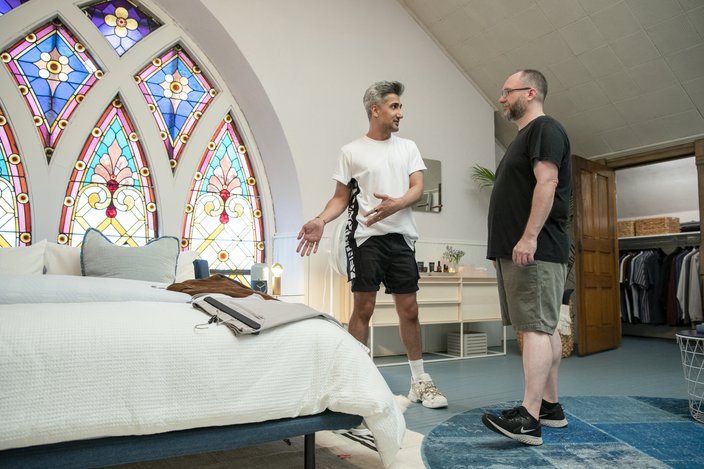
Pastor Noah gets some last-minute fashion advice from Tan France.
While Pastor Noah's story is new to most, he's been living his new life for nearly a year now. And the changes he made on the show are sticking.
Well, most of them, at least.
"I am taking more time, picking out what I wear," Hepler said, before revealing something that may make Tan cringe. "Some days if I'm not going out and I'm going to be cleaning the house, a t-shirt and that one pair of cargo shorts I kept that has an ugly ink stain from when a pen exploded that I just don't care about. So some days on cleaning days, that's what I might wear, but on the other days, I have to stop a moment — or I'm inviting myself to stop for a moment, I should say — to think about what I'm going to be doing that day and what will best help me be heard if I need to be heard. And that also includes stopping for a couple moments in the bathroom, zhuzh myself up, and then going out, instead of not caring.
"As they talk about frequently, this is not about vanity, it's about self care. There's a kind of vanity in me saying I'm not important enough — that's sort of an inverted vanity — and it's not about that. If you listen to them either inside the show or outside of it, they're talking about intrinsic human beauty that can be found in anyone, and it's about highlighting that. It's not that kind of vanity that we often worry about, and that's what I think is beautiful. That's what they're trying to teach people to do. You're beautiful. Find the way that you can express that.
"The clothing that they got for me, and the grooming products, they range [in price]. Some of that is clearly gift [quality]. I'm not going to be able to maintain that level. It's a very kind gift. But the bulk of it is stuff that I can afford even on my budget. This is something that can be done. It's not about trying to push us into an atmosphere that we can't live in."
In addition to (mostly) ditching his signature cargo shorts, Hepler has also moved out of the space above the church that Bobby renovated, in part because that area is almost completely open to the church below, and moved back into the parsonage next door. When The Fab Five arrived, they were unable to renovate that area because a leak in the ceiling had led to mold and other issues. That leak has been fixed — and a high-quality air purifier keeps him breathing safely — but more renovations are still needed, both to the parsonage and the church itself.
For example, the 125-year old stained glass windows are in desperate need of repair, but fixing them would eat up Atonement's entire operating budget for the year. And with services remaining halted until at least July as Hepler tries to keep his congregation safe from COVID-19, donations are harder to come by.
For now, Hepler lives in the partially-finished parsonage with his two cats, Thor and Sateen, the other stars of the Season 5 premiere.
"They're doing well," Hepler said. "Obviously for them, it's not sinking in that they're now Netflix stars, but they're doing well. Sateen, by the way, she's pushing 19 years old, so she's got some health problems but she's doing OK. We're looking forward to a check in with the vet after COVID really settles down."
As for Hepler, he doesn't plan on leaving his quirky Fishtown church any time soon.
"One of the things that really excites me about Atonement particularly — and they got a lot of great clips of why we might be called the quirkiest church — but I think another way we're a quirky church which they quickly realized is that it's an interesting cross-section. There's a significant number of people who have been wounded by the church who have found this community to be a part of and then that works itself into the fabric of the congregation in a way that it is a very traditional church in a lot of ways, with very unexpected outcomes from processing that tradition... It is kind of an old-school engagement with religion that at the same time is refreshed with this intensity and desire to really listen beyond just what we've heard so far... and it's a really good fit for me.
"I think I'm married to Atonement now."
To learn more about Atonement, click here. You can also follow them on Facebook, Instagram, Twitter and YouTube. Donations can be made by clicking here.
Follow Matt on Twitter: @matt_mullin
Like us on Facebook: PhillyVoice Sports


