

Sunday, September 14, 2014
Support Pastor Megan!

Wednesday, September 10, 2014
In the News: KALW
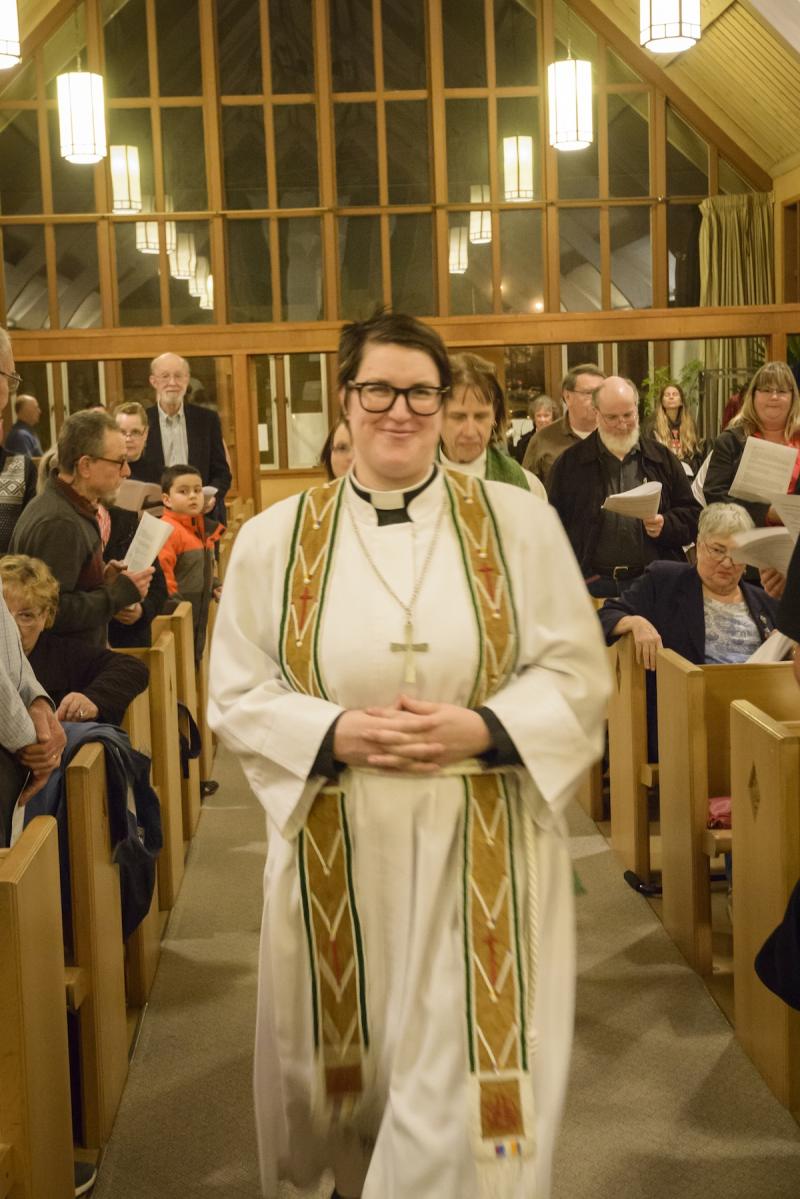
Grace Evangelical Lutheran Church sits on a quiet residential corner in the outer Sunset district of San Francisco. Upstairs in a meeting room, a small group is gathered around rectangular folding tables to sing Grace before they eat. The sound of a sweetly harmonized “Amen” floats up to the rafters of the high-ceilinged room.
Church members gather every week for a potluck dinner with their pastor-- to share food, fellowship, and spiritual conversation. The group has an easy familiarity with each other; most of the congregants are older folks who have lived in the neighborhood a long time, and have been going to this church for decades. As they eat dinner, Pastor Megan Rohrer plays a contemporary pop song as a launch pad for discussion.
Some heads nod to the beat, but it’s clear that this kind of music isn’t the normal fare for this group. The room is filled with graying heads. Then, there’s the 34-years-young pastor, who stands out for another reason, too.
“You can kind of tell from 20 feet away that I’m genderqueer, trans, or a big diesel dyke—which isn’t how I identify, but it’s how I look from the outside,” says Pastor Megan Rohrer.
Rohrer was called to lead Grace Lutheran in February 2014, becoming the first openly transgender head or solo pastor of a Lutheran Church. But Rohrer’s path to ministry was not an easy one.
“I grew up in Sioux Falls, South Dakota, which is the midwest and cultural heartland of Lutherans,” says Rohrer. “The motto [there] is like: Be in the paper when you’re born and when you die and don’t get credit for anything in between. Because your job is to just, like, fit in.”
But they actually found it hard to fit in in South Dakota. A word about pronouns here: Rohrer prefers the gender-neutral pronoun “they.” At this point in their life, they say they feel comfortable with both male and female aspects of their identity, and English doesn’t have a pronoun that captures that.
“It’s kind of a fascinating place to exist in the world—that people can’t really pin you down,” says Rohrer.
Rohrer grew up religious. They say that as a child, people recognized their gift for helping others, so ministry seemed like a good calling. But when they came out as a lesbian while attending a Lutheran college, religion was no longer welcoming.
“The people who were in my religion classes with me would sing hymns when I walked by, to try to get rid of my gay demons. And I would just sing harmony. I didn’t know what to do,” Rohrer says.
After college, Rohrer came to identify as transgender, and eventually found their way to a progressive Lutheran seminary in Berkeley. They were ordained in 2006, working extensively with homeless people and associate pastoring at several churches in San Francisco before being called to lead Grace Lutheran Church.
Rohrer says they know a lot of people have felt let down by traditional churches, places that may have been un-welcoming, fundamentalist, or judgmental.
“Identifying as trans makes people hear my sermons differently and hear what I’m saying differently,” says Rohrer. “We do something called ‘Bible Study That Doesn’t Suck’ online. It’s completely normal bible study. It just has a title that says that it doesn’t suck, which gives people the opportunity to give it a second chance -- because they think Jerry Falwell or Fred Phelps is what every Christian believes, and you should write off all Christians.”
Finding Grace
After going years without a permanent pastor, Grace Lutheran’s aging congregation was dwindling. The church council at Grace was tasked with finding a new pastor to help the congregation survive and thrive into the future.
Sally Ann Ryan is president of the council and says Rohrer was their top choice.
“She is so alive. So with today, but also with the past, with the Bible,” says Ryan. “She preaches everything from the Bible and that, but it’s in today’s language, more than most people do. She appeals to all ages, I’ve found.”
You may have noticed that Ryan is using the pronoun “she” to talk about Rohrer. Most people that I spoke to at Grace refer to their pastor as “she.” Though Rohrer prefers to use the pronoun “they” when possible, it’s not really an issue at church.
“I really am much more interested in being someone’s pastor at the end of the conversation than having them get my gender right,” Rohrer explains. “My job as a pastor is to care more about what’s going in the person I’m talking to than about what’s going on in my own life. And you can imagine that throughout the lifespan of doing ministry with people, that if your only concern was to think about what offended you, you would be a really crappy pastor.”
Rohrer’s gender identity, or the fact that their partner is a woman, was a non-issue for council president Ryan when it came to choosing a new pastor.
“What she does in her private life is up to her,” says Ryan. “What she does in her church life is what’s important.”
Pam Ryan, council president Sally Ann Ryan’s daughter, grew up at Grace. She’s in her 30s now and has a teenage son. He doesn’t come to church these days, because there are no other people his age. But she says Rohrer’s fresh perspective may just bring her son back into the fold.
At a free healthcare event the church held around Easter, the teen chatted with the pastor about safe sex, and then got to help burn palms for next year’s ashes.
“So he got to talk about condoms and lighting a fire with our new pastor,” says Pam Ryan. “So he left here like, ‘Cool, she’s cool!’”
Rohrer says that more than being a trans person, the radical thing about their presence is the age difference.
“You could multiply my age times two and I would still be one of the younger people in this congregation,” says Rohrer. “So I think it’s radical for them to have a 34-year-old who’s hanging out at their congregation and bringing life to them.”
But Rohrer says being publicly known as a church leader from a marginalized group comes with its own pressures.
“Most people don’t know other trans pastors. When you’re of a very small group there’s this sense that if you screw up, it means everybody who’s like you is not okay. Or if you screw up they’re going to pass rules saying transgender people can’t be pastors because that person screwed up,” says Rohrer. “And so there’s something really beautiful about people accepting you for the fullness of who you are so that you don’t have to be a superhero all the time. You can be Clark Kent … I get to be just a normal person who screws up the bulletin every once in a while, you know?”
Despite the occasional typo in the weekly church bulletin, Rohrer and Grace seem to be getting along just fine. Since the new pastor arrived, the congregation has grown in membership by 34 percent. Rohrer says that number is “a fancy way of saying that the congregation of sixteen grew by six people. But it sounds fancier in the percentage.”
Rohrer recently underwent a trans-related surgery.
“I let them know that I would be having surgery, that I wouldn’t be sharing with them the nature of my surgery, and that if they guessed, that was fine, but they shouldn’t tell me they figured it out,” says Rohrer. “But it’s pretty obvious: I went from like a triple D to an A, essentially.”
Rohrer says the congregation’s support during the healing process was both touching and surprising like a 98-year-old woman in the congregation who said, “Now that you’ve had this surgery, what are your pronoun choices, and are you going to be changing your name?”
Rohrer says they’re convinced that they’ve found the perfect pastoral fit at Grace Lutheran:
“People who truly embody the word Grace. Never in a million years, in a million years, did I think that I would be a part of a church that could welcome me and allow me to be a pastor fully identifying as how I am.”
So Pastor Megan Rohrer has found a spiritual home. And the Grace congregation has found just the right shepherd to lead them on their journey.
You might say it's a match made in heaven.
Friday, August 1, 2014
In the News: South Florida Gay News
The Gender Neutral Pronoun Dilemma

As any grammarian will tell you the pronoun “they” is used to refer to two or more people, but more importantly, to some trans folks, it’s gender neutral — whereas he and she are singular, but gender specific.
And that creates a grammatical dilemma.
Unlike some languages English does not have gender-neutral singular pronouns so for people like Jack Qu’emi, Brent Stanfield, and Megan Rohrer they say the language doesn’t accurately represent who they are so they’ve decided to rewrite the rules and use “they” in the singular.
“I get a lot of people saying that’s not grammatically correct,” said Jack Qu’emi, a 23-year-old student at University of Central Florida. “Usually, my first response is: Ok, my gender identity is more important than your grammar preferences, and, on top of that, singular ‘they’ has been used for hundreds of years by people like Shakespeare.”
Fred Fejes, a journalism professor at Florida Atlantic University, said the word became popular in the 70s as part of a feminist movement against a male-dominated language.
Since then, it has come to be a representation of people who don’t fit as part of either gender.
“I’m female-assigned at birth, and I’m feminine presenting, and a lot of people assume I use ‘she,’ but I think that ‘they’ is a lot more inclusive,” said 26-year-old Ray. “I identify a lot more as a feminine person than as a woman. I started using gender-neutral pronouns impulsively, and it felt really good, and I’ve been using them ever since.”
Qu’emi said the word shouldn’t be an issue because it’s also used colloquially today.
Those who use the pronoun have come up with different ways to explain it.
Taylor Collins, a 19-year-old University of Southern California student, uses the example of talking about a person of an unknown gender in a mascot outfit at a basketball game. While 21-year-old Brent Stanfield uses heritage, and famous public figures, to explain the decision to go gender-neutral.
“I think it can be helpful to talk about more famous people and instances of gender bending, like using Lady Gaga to help people understand that sometimes you can mix genders or be something out of male or female,” Stanfield said. “I think for me as a Native American, I can also sort of talk about different Native American cultures. Some of them would have more than two gender roles.”
Every day those who use “they” face challenges because of the lack of representation and general awareness of the existence of people who don’t identity as either “male” or “female.”
“One of the hardest parts are identification issues,” Qu’emi said. “You’ll be addressed based on your legal name, like on the phone they don’t care what you look like because they can’t see you. They go by what is a feminine or masculine voice.”
Qu’emi also has trouble when going to restaurants, doctors, clinics or the DMV and faces a lot of microagressions.
A microaggression is an interaction between those of different races, cultures, genders or sexual orientations, which can be interpreted as small acts of mostly non-physical aggression. The term was coined in 1970 by Chester Pierce, a noted psychiatry professor.
“Misgendering me is a microaggression, like casually being cissexist or casually not including agender individuals, casually saying, ‘Ladies and gentlemen,’” Qu’emi said. “Cissexism” is where non-trans (cisgender) people consider themselves superior to trans people. “I guess I don’t have to listen because you’re not addressing me. It usually comes exclusively from people, from individuals, and 98 percent of the time it’s done without people knowing they’re doing it.”
People like Stanfield don’t feel comfortable using “they” outside of a safe setting.
“My pronoun preference and gender identity aren’t considered to be a serious option,” Stanfield said. “Like something only someone in a liberal arts college would come up with.”
“They” still remains the only comfortable option for those who choose to identify with it.
“I’m gender fluid,” Collins said. “People can call me ‘she’ or ‘he’ and that’s fine, but I think ‘they’ is a good default for me. Most of the time I feel kind of gender neutral, and if people don’t know how I’m feeling that day, then ‘they’ is the best pronoun to go with.”
“They” offers people a chance to define themselves how they choose.
“I’m just in a place where I want to feel safe and loved and have a gender that just doesn’t feel that it’s giving anyone false information, because I really like my body, and my way in the world is in a transition place,” said Megan Rohrer, a 33-year-old transgender pastor. “’They’ accomplishes that in a way that ‘he’ or ‘she’, which tend to tip towards one side of the binary, don’t.”
Those interviewed agreed that education and public attention can bring more acceptance.
“As long as it’s controversial and media is talking about it, the more people are going to learn,” Rohrer said. “If there’s not a way to educate a lot of people across different cultures, there’s not a way for me to find true acceptance. As long as there’s controversy, people become more comfortable just through talking about it. If their first reaction was ‘I’m upset,’ their third reaction would be, ‘Oh, I heard that,’ and their third reaction would be more tolerant and accepting.”
As Stanfield puts it: “Even if it wasn’t grammatically correct, why does it matter?”
Thursday, July 24, 2014
In the News: Bay Area Reporter
Castro Lions' bountiful gifts
NEWS
Published 07/24/2014
 |
||||||||||||||||||
 | ||||||||||||||||||
Photo: Jane Philomen Cleland
| ||||||||||||||||||
Sunday, July 6, 2014
God's Wonders: A faithful exploration of the world's wonders

I'll be researching a new book project over the next few months and attempting to visit all Seven New Wonders of the World and as many of the Natural Wonders of the World as possible.
Below is a list of some of the trips I'll be taking. Watch this space to learn more about our trip.
If you'd like to follow our trip, "like" my facebook page and you'll get regular updates.
During our trip I'll be blogging and posting videos for my Travel Faithfully series. I hope our trip inspires you to see the world, to set big goals and to enjoy all the beauty of our great Earth.
Praying around the World
 |
| Sept 25-26: I traveled to the Grand Canyon in Arizona, one of the Natural Wonders of the World. See a video from my helicopter flight over the canyon. |
 |
| October 13-16 I traveled through Peru and visited Machu Picchu and Cusco. |
 |
| October 17th-19th I traveled to Easter Island in Chile. This site was a runner-up for the new 7 wonders list. |
 |
| October 20-22 I traveled to Rio de Janeiro and saw the Christ Redeemer Statue See video from our ride up Sugar Loaf Mountain |
 |
| October 23-25 I traveled to Mexico, and saw Chichen, Itza and Tulum. See video from the underwater museum in the ocean off Cancun |

December 27 we traveled to Beijing and visit the Great Wall

December 28 we traveled to Sri Lanka and visit the Temple of the Sacred Tooth Relic


Jan 1 - 4 we traveled to Jordan/Israel/Palestine visiting Petra and the Holy Land

Jan 5 we traveled to Cairo and visit the pyramids

Jan 6 we traveled to Istanbul and visit Hagia Sophia
Jan 7-8 we traveled to Rome visiting the Colosseum and Vatican


Jan 9-10 we traveled to London and visit Stonehenge
Paricutin Volcano Trek
Northern Lights Trek
Thursday, June 26, 2014
In the News: Bay Area Reporter
Shining a light on unsung heroes
Guest Opinion
Published 06/26/2014
by Michael G. Pappas
|
|
|
|
|
|
|
|
|
|
|
|
A
year ago, almost to the day, San Franciscans awaited with anxious
anticipation the U.S. Supreme Court's decisions on the Defense of
Marriage Act and Proposition 8,
California's same-sex marriage ban. On the eve of Pride, as those high
court pronouncements echoed throughout every conceivable media, we as a
community never seemed more liberated or united. We shared together in
that euphoric moment, feeling, in a profound
way, that we were both witnesses to and participants in the making of
history.
Meandering
through the masses at the Castro Street celebration of those high court
decisions, I encountered local photographer Bill Wilson who shared a
revelation, "I
just photographed a mother and her infant child and it dawned on me,
that child will never know a time when there was not marriage equality."
A hopeful realization, I thought, yet I speak to so many 20- and
30-year-olds today, whose only comprehension of the
isolation and shame of the closet and loss of friends and loved ones to
the epidemic is limited to oral history passed down or academic study.
Seen in that context, it's hard to help but feel that the human rights
victories and liberties we celebrate today
with revelry at Pride were fought, not only by today's activists, but
by the heroes of previous generations, upon whose shoulders we stand.
Not
the least among those heroes, laboring tirelessly to "increase
equality, eradicate discrimination, and protect human rights for all
people," are the commissioners,
staff, and citizen leaders who, for almost four decades have served on
the SF Human Rights Commission's LGBT Advisory Committee.
Past
chairs include such luminary LGBT activists as Martha Knutzen, and
transgender icons Theresa Sparks, the current HRC executive director,
and Health Commissioner
Cecilia Chung.
A
microcosm of our community, today's LGBT Advisory Committee comprises
of thought leaders from every sector. Lending minds and voices to the
conversation are representatives
from the nonprofits Trikone, Shanti Project, Larkin Street Youth
Services, Out4Immigration, OneJustice, API Wellness Center, Family
Violence Law Center, Transgender Law Center, Our Family Coalition, and
Forward.US. Those nonprofit leaders stand shoulder-to-shoulder
with members of the tech community, including a leader from Google's
Gaygler LGBT Employee Resource Group. Add to the mix an advocate from
the city's deaf community, members from the religious community,
including an LGBT Mormon activist and a Lutheran pastor advocating for the homeless and transgender youth; an African American
veteran activist who just finished his tenure on the city's LGBT Aging
Policy Task Force; an HIV/Infectious disease specialist; leaders in
immigration; the transgender community; a congressional
staff person and an assistant district attorney.
An
integral and vitally important component of the Human Rights
Commission, the LGBT Advisory Committee provides community involvement
and opportunity for in-depth study
and exploration of issues, offers assistance and advice to the
commission regarding discrimination against the LGBT communities,
advocates for the civil rights of persons with AIDS/HIV, and educates
our LGBT partners in advocacy about a diverse range of issues
that impact our community.
Considered
by many the unsung heroes of public policy making, the SF Human Rights
Commission's LGBT Advisory Committee, workgroups and policy and social
justice unit
staff, over the years, have researched, deliberated, presented reports,
and incubated policy measures that led to the drafting of such
legislation as domestic partners benefits, the formation of the LGBT
Aging Policy Task Force and, most recently, SF law enforcement
agencies' decision to discontinue the use of condoms when prosecuting
cases involving sex workers.
The
LGBT Advisory Committee has never been shy to take on bold and
controversial issues. Over the past decade the committee was responsible
for the formation of a task
force and held a public hearing on intersex issues, including the human
rights aspects of surgeries performed on intersex infants in order to
assign gender when the surgeries are not medically necessary. Both the
advisory committee and commission urged the
Board of Education to pass a resolution to establish a high school
course on LGBT history, politics, and culture and commit to funding LGBT
support services. It held panel discussions and community meetings to
study bisexual invisibility and issued a report
entitled, "Bisexual Invisibility: Impacts and Recommendations."
Together with the commission it held a public forum on unrecognized
families and issued a report "Beyond Marriage: Unrecognized Family
Relationships." It initiated a resolution unanimously passed
by the commission urging lawmakers and the governor to enact state
Senate Bill 1172, making it illegal for state-licensed psychologists to
practice "reparative therapy" on minors.
Current
issues being addressed by the advisory committee's work groups include
comprehensive immigration reform for impacted LGBTQ individuals and
families; deaf and
people with disability advocacy for LGBTQ individuals; keeping
nonprofits serving the LGBT community in San Francisco; advocacy related
to trans empowerment for immigrant trans women and trans women of
color; research, advocacy and a policy review of the city's
ID program and the program's impact on transgender residents with
respect to name and gender change; and advocacy related to bridging the
gap between the tech and LGBTQ communities.
Among
the issues emerging from the commission's policy and social justice
unit are the call for comprehensive transgender health care reform in
the Healthy San Francisco
program; the creation of a long needed LGBTQ youth citywide sensitivity
training and cultural competency program required by an ordinance, on
which we partnered with the Youth Commission; reports on human
trafficking, anti-bullying initiatives and equity and
inclusion of communities of color in the LGBT community. That unit is
also working diligently to support efforts to develop policies and
guidelines that would facilitate gender neutral bathrooms and public
accommodations for transgender individuals.
Pride
means different things to different people. For the SF Human Rights
Commission's LGBT Advisory Committee, it is the occasion to recommit
ourselves to laboring for
and securing the rights and freedoms our community deserves. In sharing
this brief overview of our work we invite you to join us in honoring
those heroes who came before us by helping to write the next chapter of
our exciting movement.
Saturday, June 21, 2014
Pre-Order two upcoming books!
Pre-Order Our Upcoming Titles:


With A Day Like Yours Couldn't You Use a Little Grace: Daily Grace for Diverse People Living in a Complicated World
This book, by our Pastor Megan Rohrer, is for everyone who has been lied to and told that God couldn’t
love them. In addition to reminding you that nothing, nothing, nothing can ever
separate you God’s love, Pastor Megan Rohrer will also help you learn to accept
this gift of grace and love yourself just as you are.
Whether you skim, only pull it out when you have a rough day or a bad breakup, or make readings part of your daily routine for a year, With a Day Like Yours, Couldn’t You Use Some Grace speaks to saints, sinners and everyone in between.
Whether you skim, only pull it out when you have a rough day or a bad breakup, or make readings part of your daily routine for a year, With a Day Like Yours, Couldn’t You Use Some Grace speaks to saints, sinners and everyone in between.
Pre-order the May-August Edition
Bible Study that Doesn't Suck: An Illustrated Retelling of The Gospel According to Mark
This
Bible Study, by our Pastor Megan Rohrer, will be available in
December. You can help us get this book printed by pre-ordering your
copy now at a reduced rate.
Ready to check out? Click the button below.
Subscribe to:
Posts (Atom)